Steam Cleaner vs Upholstery Cleaner: What’s Better for Deep Cleaning?
When you think “deep clean,” you probably picture powerful heat or aggressive suction pulling long-embedded dirt out of fabrics and grout. But steam mops and upholstery/spot cleaners are very different tools built for different jobs. Choosing the right one depends on the surface, the kind of soil (grime vs. trapped pet dander vs. oily stains), and how quickly you need the item to dry.
Below I’ll compare both tools in detail, show when each is the right pick, and include real product examples so readers can see what to buy and why.
Table of Contents
Quick summary: the short answer
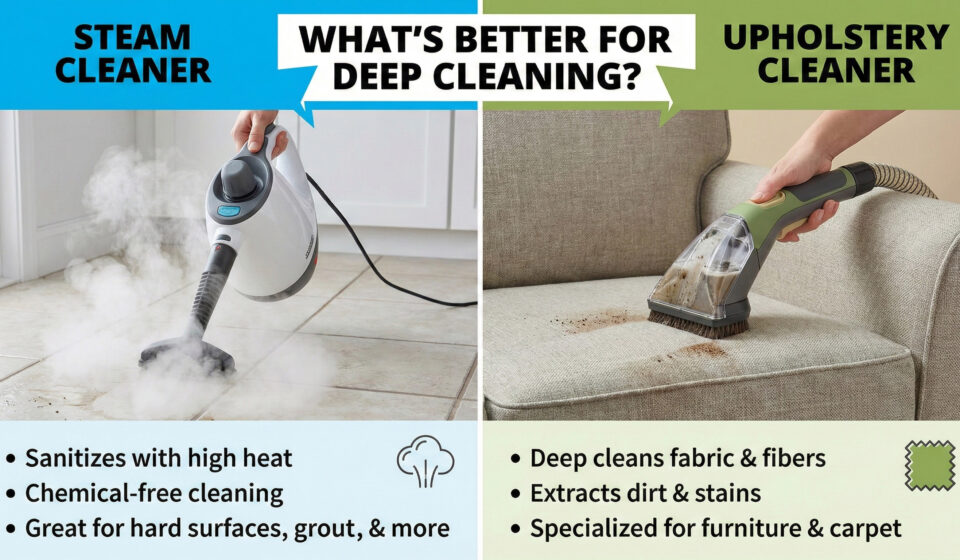
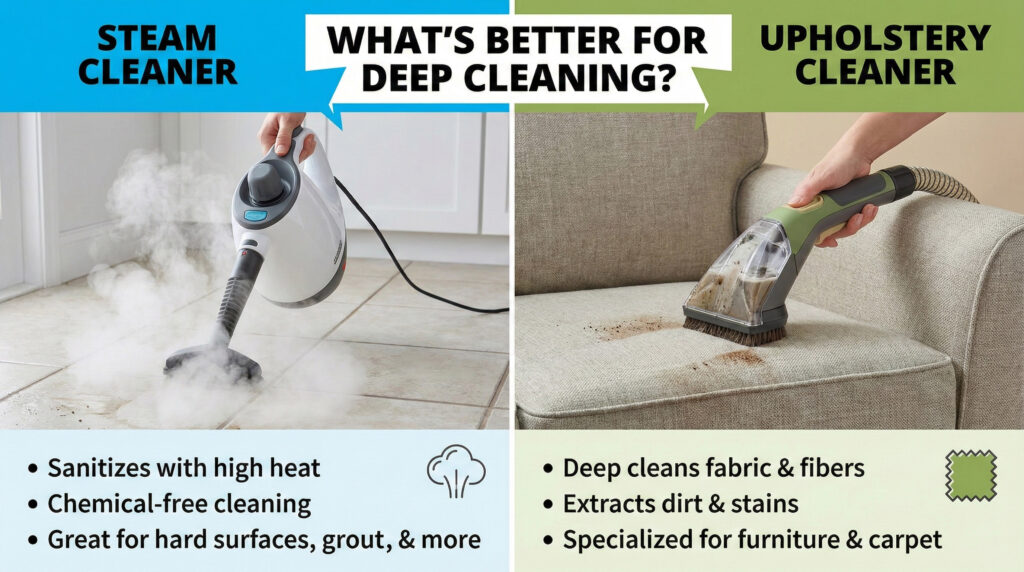
- Steam mops → Best for sealed hard floors (tile, porcelain, sealed stone). They use heat and vapor to sanitize and loosen grime; they’re not made for upholstered fabrics and can damage moisture-sensitive surfaces (like many laminates). (See product example: Shark Steam & Scrub S8001C).
- Upholstery / spot cleaners → Best for fabric surfaces, upholstery, area rugs, car seats. They use water + cleaning solution + vacuum extraction (or brush + suction) to remove deep stains and extract soiling — they’re designed for absorbent materials. (See example: BISSELL SpotClean line).
Use a steam mop to clean floors; use an upholstery cleaner for sofas, mattresses, and carpeted areas. When in doubt about a fabric or floor finishing, test a small patch first.
How the machines differ (mechanics & intent)
Steam mop (what it does)
No products found.
- Heats water to create steam; steam loosens dirt, sanitizes, and the mop pad lifts residue.
- Some modern units combine steam with rotating scrub pads (more mechanical agitation) for better stain removal on hard floors. Example: Shark Steam & Scrub S8001C (3 steam modes, rotating scrub pads, LED headlight, ~19ft cord).
- Moisture level: low-to-moderate vapor — still enough to cause problems on moisture-sensitive materials if misused.
Upholstery / spot cleaner (what it does)
No products found.
- Sprays a measured mix of water + cleaner, agitates with brushes or hand tool, then extracts liquid and dissolved soil using vacuum suction.
- Designed for wet extraction — the machine pulls most of the liquid back out, leaving the fabric damp, not saturated. Example families: BISSELL SpotClean / SpotClean Pro, Hoover spot/carpet machines.
- Moisture level: higher application than steam (wet extraction), but built to extract so fabrics dry within hours.
Performance on common surfaces (detailed)
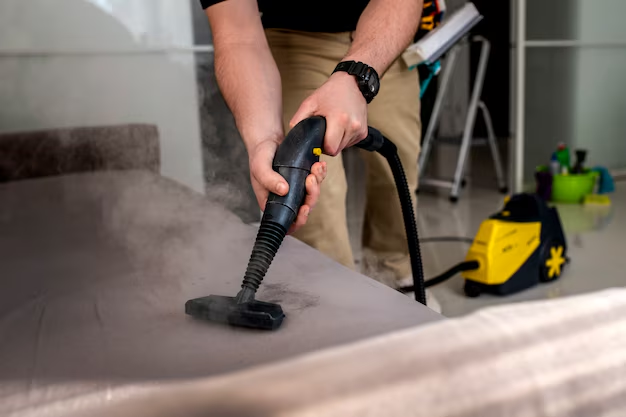
1. Upholstery (sofas, cushions, mattresses)
- Upholstery cleaner: superior — designed for cleaning fabric, removes embedded stains (food, pet urine spots, body oils), and extracts water/solution. Drying time typically 2–6 hours depending on ventilation. Professional spot cleaners perform better on thick, deep stains because they flush and extract.
- Steam mop: not recommended — steam can drive moisture into cushions and backing, won’t extract soil effectively, and can encourage shrinkage, dye run, or mold if fabric and backing hold moisture.
Verdict: Use a spot/upholstery cleaner.
2. Area rugs & carpeted stairs
- Upholstery/spot cleaner: best for localized stains and small rugs (portable models like BISSELL SpotClean handle stairs/rugs well). For full rugs, upright or professional carpet extractors are better.
- Steam mop: ineffective — designed for hard, sealed floors and won’t extract cleaning fluid; can leave carpets soaked.
Verdict: Upholstery/spot cleaner for spot cleaning; professional extractors for whole-rug deep clean.
3. Hard floors (tile, sealed stone, sealed hardwood)
- Steam mop: ideal for tile, grout, sealed stone; sanitizes and loosens grime. Models with scrubbing pads (e.g., Shark S8001C) combine agitation + steam for better stuck-on stain removal on sealed hard floors.
- Upholstery cleaner: not appropriate — no real advantage on hard floors and not designed to cover large flat areas efficiently.
Verdict: Use a steam mop on sealed hard floors.
4. Laminate & engineered hardwood
- Upholstery cleaner: irrelevant
- Steam mop: often not recommended. Many laminate / engineered wood manufacturers warn against steam because heat + vapor can seep into seams and cores, causing swelling or delamination over time. If your laminate is explicitly rated by the manufacturer for low-moisture cleaning only, avoid steam. (Confirm with flooring docs).
Verdict: Avoid steam mops on laminate; use a damp microfiber mop instead.
Product deep dives (concise but detailed)
Below are two product examples — one steam mop and one spot/upholstery cleaner — to use in the article as contextual recommendations.
Shark Steam & Scrub S8001C — what it offers
- Type: Steam mop / scrubbing combo for sealed hard floors
- Key specs & features: 3 steam modes (Light / Normal / Deep), rotating scrub pads, LED headlight, 19 ft cord, washable pads included. Good for tile, sealed hardwood, stone.
- Real user pros (aggregate):
- Strong scrubbing action on stuck stains
- Adjustable steam useful for different messes
- LED headlight helps find debris
- Generally positive user satisfaction for sealed hard floors
- Real user cons (aggregate):
- Tank refill for long sessions (typical for stick units)
- Not suitable for moisture-sensitive floors (laminate, unsealed wood)
- Must be used carefully to avoid dwell time on one spot
- Ideal use case: households with tile, stone, or regularly sealed hardwood that want deeper cleaning without chemicals.
BISSELL SpotClean (SpotClean Pro / SpotClean ProHeat examples) — what they offer
- Type: Portable spot/upholstery cleaner with spray, brush agitation, and suction extraction.
- Key specs & features (SpotClean Pro family): onboard hose (≈1.5 m), concentrated solution compatibility, dual tank systems on some models, strong suction for spot extraction; designed for upholstery, carpets, car interiors.
- Real user pros (aggregate):
- Very effective on pet stains, food stains, and spills
- Portable — reaches stairs, inside cars, tight spots
- In many cases removes stains regular vacuuming can’t touch
- Real user cons (aggregate):
- Requires cleaning solution (chemical), though many formulas are safe/eco options
- May need repeated passes on old/stubborn stains
- Some models need maintenance to keep hoses/nozzles from clogging
- Ideal use case: homes with sofas, kids, pets, or cars — where fabric stains and odors need targeted extraction.
Head-to-head comparison table
| Criterion | Steam Mop (e.g., Shark S8001C) | Upholstery / Spot Cleaner (e.g., BISSELL SpotClean) |
|---|---|---|
| Primary surfaces | Sealed hard floors (tile, stone, sealed wood) | Fabrics: upholstery, area rugs, carpet spots, car seats |
| Soil types best removed | Sticky grime, dried spills, surface bacteria | Embedded stains, pet urine, oil, food stains |
| Sanitizing ability | High (heat) | Moderate — relies on chemical cleaners + extraction |
| Drying time | Fast on hard floors | 2–8 hours on fabrics (ventilation speeds up) |
| Risk to materials | High on laminate & unsealed wood | Low for fabrics (follow label) |
| Mobility/portability | Lightweight, easy to store | Portable units; hoses can reach tight areas |
| Maintenance | Pads washable, descaling recommended | Tanks/hose cleaning; filters/brushes maintenance |
| Cost (typical) | Mid-range to high | Mid-range; professional units cost more |
Real-world scenarios and recommended tool
Scenario A — You have tile floors and a fabric sofa with kids
- Use a steam mop (Shark) for tile/mud; use a SpotClean for the sofa’s stains. Two tools, distinct jobs.
Scenario B — You have laminate floors and occasional sofa spills
- Avoid steam mops. Use a microfiber damp mop for floors. For sofa spills, use an upholstery extractor (BISSELL SpotClean).
Scenario C — You run a rental or BnB and need quick turnover
- Steam mops can sanitize floors fast (tile bathrooms/kitchens). Upholstery extractor for mattress/sofa spot cleans between guests — combine both if both surface types are present.
How to deep clean safely (step-by-step best practice)
Steam mop (for sealed hard floors)
- Sweep/vacuum to remove loose debris.
- Select lowest steam setting for light cleaning. Use higher only for tough spots.
- Keep mop moving; never hold the steam head on one spot.
- Wipe up excess moisture with a microfiber cloth if needed.
- Allow floor to air dry; ventilate room.
Upholstery / spot cleaner (for fabrics)
- Vacuum upholstery first to remove loose debris.
- Test cleaning solution on a hidden patch for colorfastness (wait 10–15 minutes).
- Use the smallest effective amount of solution; agitate with the tool’s brush.
- Extract thoroughly — repeat until suctioned water is visibly cleaner.
- Blot with clean microfiber; ventilate and speed drying with fans.
Maintenance & longevity tips
- Steam mops: Descale regularly per manufacturer instructions; machine pads after each use; store dry. Avoid using softeners on pads (reduce absorption).
- Upholstery cleaners: Empty/clean tanks after each use; run clean water through hoses occasionally (hydro-rinse) to prevent clogging; filter checks.
Cost vs value (practical buying note)
- Entry to mid-range steam mops (with capable features like rotating pads and variable steam) typically cost more than basic mops but deliver better stuck-on stain removal on hard floors. The Shark S8001C is an example of a model that upgrades steam cleaning with mechanical scrubbing.
- Portable upholstery extractors are an efficient investment for pet owners or families — they solve stains that regular vacuums can’t, and even inexpensive models (BISSELL SpotClean family) deliver strong spot cleaning performance.
Buyer’s checklist — which to get?
Choose a steam mop if:
- Your home is mostly tile, sealed stone, or well-sealed hardwood
- You want chemical-free sanitization
- You accept limitations on laminate/engineered wood
Choose an upholstery/spot cleaner if:
- You need to remove stains from fabrics (sofas, rugs, car seats)
- You have pets or kids and frequent spot cleaning is needed
- You need a portable unit that extracts moisture
If you need both capabilities in one household (common), buy both — they’re complementary, not interchangeable.